Apex
Stake off your peak, bank your doubles — a two-bank ratchet staking system.
Open Apex →Apex is a faithful rebuild of an original two-bank ratchet staking system — a professional method, decades old, that keeps half the bankroll in reserve while ratcheting the other half upward in protected cycles. Verified against its source workouts, available nowhere else.
Overview
Apex is a professional two-bank ratchet staking system. You split your capital in two: an Operating Bank you actually bet from, and a Reserve Bank you never touch. Your stake is a fixed percentage of the Operating Bank’s highest point so far — its “peak” — so within a run your stake ratchets up and never drops.
When the Operating Bank doubles, the two banks merge and re-split into a bigger fresh start, with profit locked safely into a larger Reserve. If it instead halves, the same merge resets you to safer ground before a bad run can run away. It does not pick selections — you bring those — it manages the money around them.
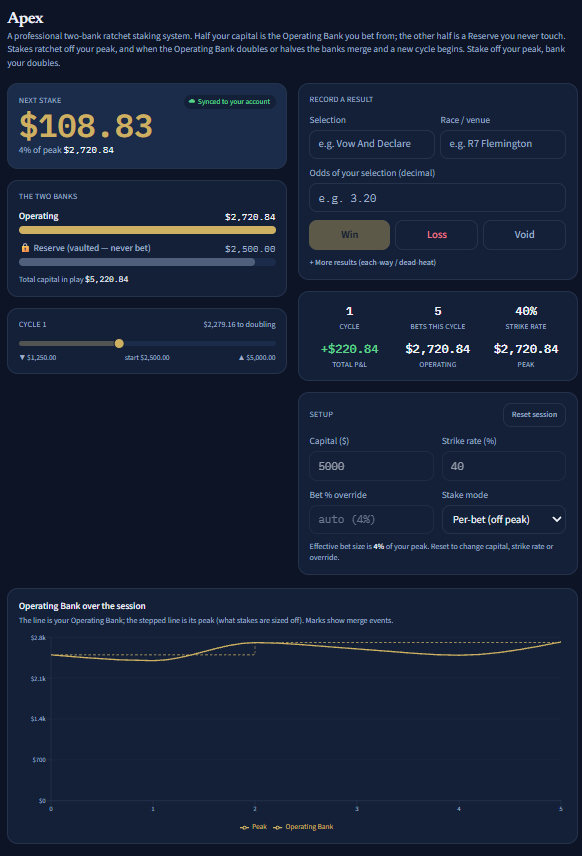
The two banks
Your capital is divided in half. The Operating Bank is the working half — every stake comes out of it and every result lands in it. The Reserve Bank sits to one side, vaulted: it is never staked and only ever changes at a merge. Keeping half your money out of play is the system’s core safety feature.
Capital $4,000 → Operating Bank $2,000 · Reserve Bank $2,000
You bet only the $2,000 Operating Bank; the $2,000 Reserve is untouched.
Your bet size
Apex sizes each stake as a small percentage of the Operating Bank’s peak. The percentage comes from your expected strike rate — roughly your strike rate divided by ten, kept within a designed 2–5% band (a 40% strike rate gives 4%). You can override it (1–8%), but going outside 2–5% shows a warning, because that’s outside what the system was designed for.
Strike 20% → 2%   ·   30% → 3%   ·   40% → 4%   ·   50% → 5%
At 4% of a $2,000 peak, your stake is $80.
The ratchet
The key rule: your stake is a percentage of the peak, not of the current bank. So within a cycle the stake only ever goes up or stays flat — it never decreases, even after a loss. A win lifts the peak, which lifts the next stake; a loss leaves the peak (and therefore the stake) where it is until you make a new high.
Peak $2,000 → stake $80. Win at $3.00 → Operating Bank $2,160, new peak $2,160.
Next stake = 4% of $2,160 = $86.40.
Now a loss of $86.40 → Operating Bank $2,073.60, but the peak stays $2,160…
…so the next stake is still $86.40 (it ratchets, it doesn’t drop).
Doubling & drawdown — the merge
Each cycle has two finish lines, measured against the Operating Bank at the cycle’s start. Hit the top one — the Operating Bank doubles — and you merge: both banks are added together and split in half again, starting a new cycle from a higher base with your winnings now protected in a bigger Reserve. Hit the bottom one — the Operating Bank halves — and the same merge fires, pulling Reserve across to reset you before the run gets worse. (An odd cent on a split always goes to the Reserve.)
Doubling: Operating reaches $4,000 → merge $4,000 + $2,000 = $6,000 → new $3,000 / $3,000. New stake 4% of $3,000 = $120.
Drawdown: Operating falls to $1,000 → merge $1,000 + $2,000 = $3,000 → new $1,500 / $1,500. New stake 4% of $1,500 = $60.
Either way the banks re-balance to equal halves and a fresh cycle begins from the new Operating Bank.
Per-bet vs Daily Lock
In the default Per-bet mode the stake is recomputed from the peak before every bet, so it climbs the moment you make a new high. In Daily Lock mode the stake is fixed once at your first bet of the day (Sydney time) and reused for every bet that day, even if the peak rises — handy if you place several bets at a known stake. The next day it re-locks at the new level.
Running a session — how to use it
- 1Set your capital, your expected strike rate (it shows the bet % it derives) and the stake mode.
- 2Read the next stake in the hero, and the “to doubling” distance on the cycle meter.
- 3Optionally note who you’re backing (the runner) and the race/venue, then enter your selection’s decimal odds to preview the return.
- 4Tap Win, Loss or Void (Half-win / Half-loss are under “more” for each-way and dead-heats).
- 5Watch the banks, the peak tick and the cycle meter move; a merge pops a toast and starts a new cycle.
- 6Use Undo to reverse the last result; sign in to sync across devices.
Reading the screen
- Stake hero — your next stake, with the “% of peak” it’s sized from (and a lock chip in Daily Lock mode).
- Two banks — Operating (what you bet) vs Reserve (vaulted, never bet).
- Cycle meter — how close the Operating Bank is to doubling (top) or the drawdown floor (bottom), with a tick at the peak.
- Chart — the Operating Bank over time, the stepped peak it’s sized from, and a mark at each merge.
- Stats — cycle number, bets this cycle, strike rate so far, total P&L, current vs peak.
- History — every bet you’ve recorded with its selection, race, odds, result, stake and P&L (with Undo).
Free vs Pro
The free preview gives you the full calculator and saves your session, capped at 30 recorded bets so you can try the system end to end. Pro removes the cap for unlimited bets. Your saved history is never trimmed either way.
Suggested strategy
- Set your strike rate honestly — it sets your bet %, the single biggest dial. When unsure, go lower (a smaller %).
- Let the Reserve do its job: it’s meant to sit idle. Pulling money out of it defeats the system.
- Treat a drawdown merge as the plan working, not failing — it’s re-balancing you before a cold run deepens.
- Pick odds with a steady strike rate; the ratchet rewards regular winners more than occasional long shots.
- Pressure-test your capital in the Bankroll Variance tool first, so you know the losing run you must survive.
Tips & common mistakes
- The stake sizes off the peak, not the current bank — don’t be surprised it doesn’t fall after a loss.
- Half your money is meant to be idle. The Reserve is the safety net; leave it alone.
- No staking plan changes the odds. A long losing run still loses — the merge limits the damage, it doesn’t prevent it.
- Enter your real expected strike rate; an optimistic number sets your stakes too high.
FAQ
- Why didn’t my stake go down after a loss?
- By design. Apex sizes the stake off the peak (your high-water mark), so it holds steady until you make a new high — that’s the ratchet.
- What happens at a merge?
- The two banks are added together and split into equal halves, starting a new cycle. A doubling merge locks in profit; a drawdown merge resets you to safer ground. Any odd cent goes to the Reserve.
- Do I ever bet the Reserve?
- No. The Reserve is never staked. It only changes when a merge re-balances the two banks.
- What’s the difference between the stake modes?
- Per-bet recomputes the stake from the peak before each bet; Daily Lock fixes it at your first bet of the day and reuses it all day.
Responsible play
A staking plan changes how much you stake, not whether a bet wins, and nothing removes the house edge. These tools are educational calculators — they do not place bets, take money, or give tips.
Set a daily loss limit and, if you need a break, a cool-off in Settings. Never stake money you cannot afford to lose. Free, confidential support: National Gambling Helpline 1800 858 858 (24/7).
What's free, what's not
The free preview records up to 30 bets per session; The Grail removes the cap. Your bets are always saved and replayed in full — only new input past the preview pauses. Apex is one of the six Grail Systems.
One email a month on staking systems and bankroll maths — no tips, ever.
OutlayHQ is educational staking & bankroll-management calculator software. It does not place bets, take money, or provide betting tips. Gambling involves risk — never bet more than you can afford to lose. For free, confidential support call the Australian National Gambling Helpline on 1800 858 858.