Edge Protocol
Value-betting stake sizing and closing-line-value analysis.
Open Edge Protocol →Edge Protocol is built on the Kelly criterion — the stake-sizing maths professional bettors and investors have used since the 1950s — wrapped in commission-aware sizing, safety vetoes and closing-line-value tracking you won’t get from the textbook formula.
Overview
Edge Protocol is for bettors who form their own probability estimates. It converts your estimated edge into a disciplined stake and helps you measure closing-line value (CLV) — whether the price you took beat the market’s final price.
It is built around capital protection: clear verdicts, hard vetoes, and stake caps keep a good idea from becoming an over-bet.
Before you start
You need your own honest estimate of a runner’s win probability (as a %), the decimal price available, and your bankroll. The output is only as good as your probability — optimistic inputs lead to over-staking.
Stake sizing — how to use it
- 1Enter your bankroll.
- 2Enter your assessed win probability and the available decimal price.
- 3Set the account/race context (this adjusts the recommended fraction and caps).
- 4Read the edge it detects, the recommended stake, the verdict (BET / PASS / HARD_PASS) and the expected value.
- 5Place only what it recommends — the cap is there on purpose.
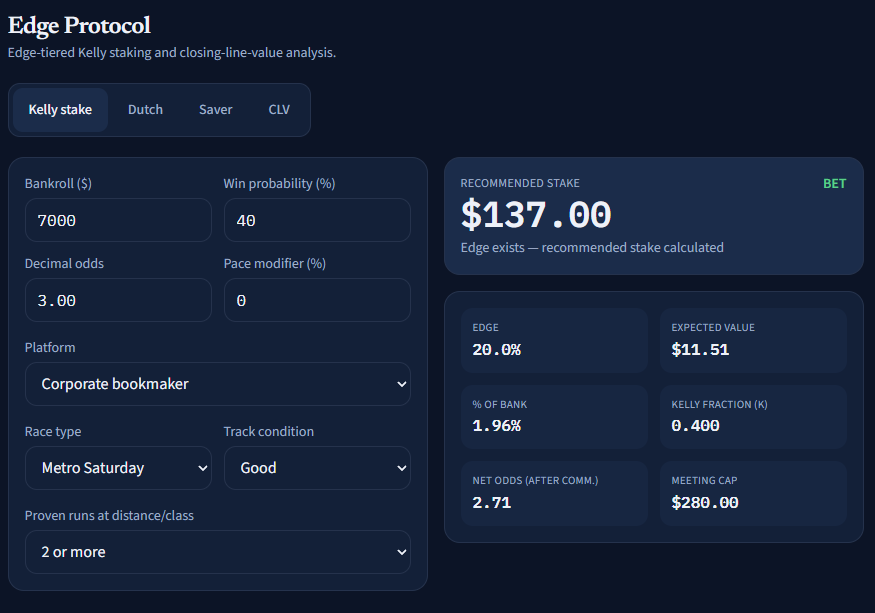
Bankroll $7,000 · your probability 40% · price 3.00
→ the tool reads a 20% edge and recommends a $137 stake
→ verdict BET · expected value ≈ +$11.50
Stakes are floored to whole dollars and capped at a maximum % of bankroll per meeting.
Understanding the stake
The recommended stake grows with two things: how big your edge is, and how big your bankroll is. A larger edge earns a larger slice; a larger bank scales everything up in proportion.
It is a fractional approach by design. Staking the full theoretical amount maximises long-run growth but swings hard, so the tool sizes a fraction of it and caps the stake per meeting — protecting your bank from a single optimistic call.
Everything hinges on your probability estimate. If your number is generous, the edge is overstated and so is the stake. Honest, defensible probabilities are the engine here; the maths just executes them faithfully.
Which odds suit it
Value betting isn’t tied to an odds band — it’s tied to having a genuine edge, and value can exist at any price. What changes with the odds is reliability and variance.
In practice your probability estimates are usually firmest at short-to-mid prices, while long odds carry much higher swings. A sensible rule of thumb: the longer the price, the smaller the fraction of the recommendation you actually stake. Below about $2 you need real confidence in your number for the edge to be worth it.
Recommended setups
Cautious    — quarter of the recommended stake · focus on $2–$5 where your read is firmest
Balanced    — half of the recommended stake · $2–$8 · take every PASS verdict seriously
Aggressive  — closer to the full (still capped) stake · will take $8+ value, accepting bigger swings
Whatever the style, the honesty of your probability matters more than the odds band.
Safety vetoes
- Edge below your meeting minimum → verdict PASS, stake zero.
- A drying track → a hard veto (HARD_PASS) regardless of edge.
- A very large edge is still capped at the per-meeting maximum stake.
Closing-line value (CLV) — how to use it
CLV compares the price you took with the closing price. Consistently beating the close is one of the few objective signs that your selections carry real value.
- 1After a race, enter the price you took and the closing price.
- 2Read the CLV verdict (positive / neutral / negative).
- 3Log it over many bets — the trend is what matters, not any one result.
You took 4.00; the market closed at 3.60 → +11.1% CLV (positive)
Within about 2% of the close → neutral
Dutch & saver helpers
The Dutch helper splits a stake across runners for an equal return whichever wins and flags any runner with too little individual edge. The Saver helper splits a race stake across a main bet and one or two savers to cap the downside.
Dutch $100 across two runners at 3.00 (you rate each 40%) → $50 / $50, $150 back whichever wins
Saver: a $75 main bet → $75 / $17.50 / $7.50 across the primary and two savers
Suggested strategy
- Stake a fraction of the full recommendation (many bettors use a quarter or half) to smooth the swings.
- Let the PASS verdict do its job — discipline on the bets you skip is most of the edge.
- Judge yourself on closing-line value across 100+ bets, not on wins and losses in the short run.
- Be ruthless about honest probabilities; if you can’t justify the number, don’t bet it.
- Set the account context accurately so the caps reflect where you’re actually betting.
Tips & common mistakes
- Overconfidence is the classic error — it quietly turns a sound method into over-staking.
- One winning bet doesn’t validate your model; one losing bet doesn’t break it.
- Track CLV honestly even when the bet lost — beating the close is still a good sign.
FAQ
- What is "edge"?
- Your view that a price is bigger than it should be, given your probability. Positive edge means value in your favour.
- Why did it tell me to PASS?
- Your estimated edge was below the minimum, or a hard veto (such as a drying track) applied.
- Should I bet the full recommendation?
- It’s sized for growth but can be volatile — many bettors stake a fraction of it.
Responsible play
A staking plan changes how much you stake, not whether a bet wins, and nothing removes the house edge. These tools are educational calculators — they do not place bets, take money, or give tips.
Set a daily loss limit and, if you need a break, a cool-off in Settings. Never stake money you cannot afford to lose. Free, confidential support: National Gambling Helpline 1800 858 858 (24/7).
What's free, what's not
Edge Protocol’s calculators are free to use. It is one of the six Grail Systems — The Grail unlocks it at full depth as the platform grows.
One email a month on staking systems and bankroll maths — no tips, ever.
OutlayHQ is educational staking & bankroll-management calculator software. It does not place bets, take money, or provide betting tips. Gambling involves risk — never bet more than you can afford to lose. For free, confidential support call the Australian National Gambling Helpline on 1800 858 858.