Proving Ground
Prove it before you stake it — backtest every staking plan on your own betting.
Open Proving Ground →Overview
Proving Ground is a staking-plan backtester. It takes a run of already-decided bets — their odds and whether each won or lost — and replays them through 21 different staking plans at once, so you can see which plan would have made the most from the same bets, and which would have busted along the way.
It does not pick selections and it does not predict the future. It answers one question: given how you actually bet, how would each way of sizing your stakes have performed? Crucially, it ignores the stake you originally used — it only needs each bet’s odds and result, then re-stakes that same sequence under every plan.
Where your bets come from
- My Bet Tracker — replays the settled bets you’ve logged in the Bet Tracker (signed in). The most useful source, because it’s your real betting. (Pro)
- Import a file — upload a CSV or Excel export from a spreadsheet or bookmaker; you map the odds and result columns. Feeds the backtest only — it never adds anything to your Bet Tracker. (Pro)
- Synthetic — generate a realistic run of bets from a strike rate, average odds and spread. Great for trying the tool or stress-testing a plan at a chosen win rate. (Free)
Before you start
You need a sequence of settled bets with decimal odds and a result (win / loss / void / half / push). Order matters — staking plans react to wins and losses as they happen — so keep the bets in the order you placed them. Set a starting bank and, if your exchange charges it, a commission, so the effective odds are right.
A backtest is most meaningful over a decent sample: a few hundred bets shows a plan’s behaviour far better than a dozen. The same bets are used for every plan, so the comparison is always like-for-like.
The 21 staking plans
Fifteen classic plans are free with an account, and the six Grail Systems join them as plans on The Grail. They fall into families, from steady to volatile; you can run any mix, and each has a sensible default so you can select and run with zero setup.
- Flat & proportional — Level stakes (a fixed % of your starting bank), Percentage of bank (a fixed % of your current bank), Square Root and Step Percentage: steady staking with little structure.
- Progression — D’Alembert, Fibonacci, Labouchère, 1-3-2-6, Parlay and Up X / Down Y: structured step-ups and step-downs.
- Recovery — Stop-at-winner, Target Profit, Retirement and 6-Point Divisor: these lift stakes through a losing run to claw it back.
- Martingale — doubles after every loss. It carries a permanent “high ruin risk” badge and is included as the cautionary tale, not a recommendation.
- The Grail Systems (The Grail) — Resurgence, The Mint, Regal, Compound bank, Apex and fractional Kelly: the six proprietary systems, runnable as plans alongside the classics.
Running a backtest — how to use it
- 1Data tab — choose a source (Synthetic, My Bet Tracker, or Import a file) and load the dataset. A summary card shows the bet count, realised strike rate and average odds.
- 2Plans tab — tick the plans to compare. Open a plan’s drawer to adjust its one or two knobs, or leave the defaults.
- 3Run the backtest — every selected plan is replayed over the same bets (off the main thread, so the page stays responsive; you can cancel a long run).
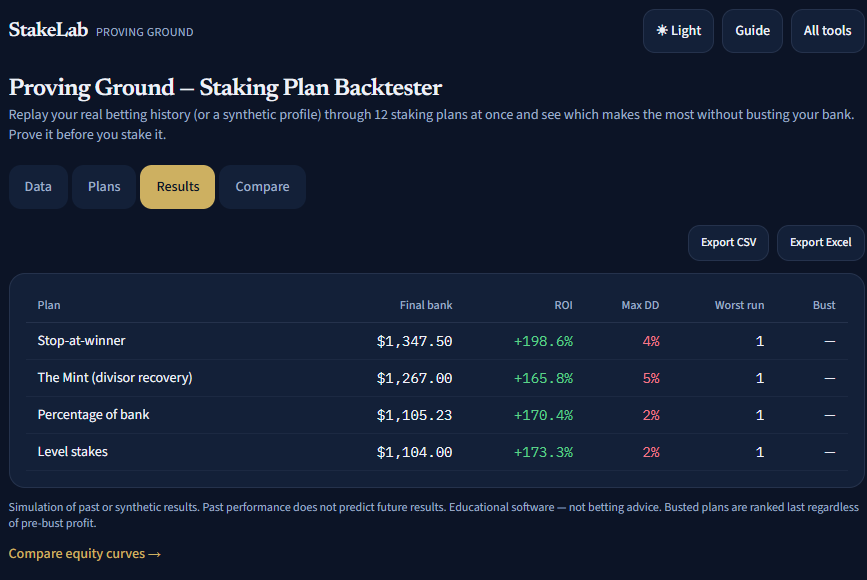
- 4Results tab — read the ranked table; plans that busted sink to the bottom.
- 5Compare tab — overlay the equity curves to see not just where each plan finished, but how bumpy the ride was.
Reading the results
- Final bank & net P&L — where each plan ended from the same starting bank.
- ROI / POT — profit relative to total staked, and relative to your starting bank.
- Max drawdown — the worst peak-to-trough dip along the way. A bigger final bank with a deep drawdown is a bumpier, riskier ride.
- Max stake — the largest single bet a plan demanded; recovery and progression plans can balloon this.
- Longest losing run — the worst cold streak in the data (the same for every plan).
- Busted — whether the plan ran out of bank (and at which bet). A busted plan is ranked last no matter how it looked beforehand.
Worked example — the same bets, six very different outcomes
Level stakes        → $1,462    (max drawdown 18%)
Percentage of bank  → $1,482    (drawdown 26%)
Resurgence          → $1,834    (drawdown 27%)
The Mint            → $2,154    (drawdown 53%)  ← biggest gain, bumpiest ride
Fibonacci           → BUSTED at bet 122
Martingale          → BUSTED at bet 45
Every plan saw the identical 150 bets — a collectively profitable run — yet two progressions still busted, and the plan with the largest profit also had by far the deepest drawdown. That trade-off is exactly what the tool is for. Figures are from this synthetic dataset; your own history will differ.
The shuffle test (Pro)
A single backtest is one ordering of your bets — and luck of the draw in that order can flatter or punish a plan. The shuffle test re-runs the same bets in hundreds of different orders and reports the spread: the median final bank, the unlucky (10th-percentile) and lucky (90th-percentile) cases, and how often each plan busts.
It’s the difference between “this plan won once” and “this plan wins reliably.” A plan with a high median and a low bust rate is robust; one that wins big in the best order but busts often is just gambling on sequence.
Saving & exporting
Save a backtest as a named experiment (Pro) and it stores your data setup, the plans and the seed — not the numbers. When you reload it the results are recomputed from scratch, which is also a neat proof that the engine is deterministic: same inputs, same answer every time.
Export the results table to CSV or Excel (Pro) to keep or analyse elsewhere. The Excel file keeps money and percentages as real numbers, so you can sort and total them in the spreadsheet.
Free vs Pro vs The Grail
Free runs synthetic datasets through all 15 classic plans. Pro unlocks your real Bet Tracker history and file import as data sources, the shuffle test, saved experiments, and CSV / Excel export. The Grail adds the six Grail Systems as selectable plans.
Suggested strategy
- Backtest your own history, not just synthetic data — the point is how each plan fits the way you actually bet.
- Don’t crown the biggest final bank. Check its drawdown and max stake too: a plan you can’t emotionally or financially sit through is the wrong plan.
- Treat a bust as disqualifying. A plan that busts on your history would have wiped you out in real life.
- Use the shuffle test before trusting a result — robustness across many orderings beats one lucky run.
- Cross-check a stake size in the Bankroll Variance tool: Proving Ground shows how plans performed, Variance shows the losing run you must be capitalised to survive.
Tips & common mistakes
- Past performance — real or synthetic — is not a prediction. A plan that won on your last 300 bets can still lose on the next 300.
- Keep your bets in the order they were placed; shuffling the order by accident changes every recovery and progression result.
- A backtest can’t rescue losing selections. If your bets are collectively unprofitable, no staking plan makes them profitable — it only changes how fast you lose.
- Imported files feed the backtest only; they never touch your Bet Tracker.
FAQ
- Does Proving Ground take results from my other calculators?
- Not as data. Its real-data source is the Bet Tracker (the bets you log there). It does include several tools’ staking methods — Resurgence, The Mint, Regal, Compound and Kelly — as plans you can compare, but it doesn’t read figures out of those calculators.
- Does it use the stake I originally placed?
- No. It deliberately ignores your original stake and re-sizes every bet under each plan; it only needs each bet’s odds and result.
- Will the best backtested plan win for me next time?
- No staking plan changes whether a bet wins or removes the house edge. The backtest shows how plans behaved on a past or synthetic run — use it to understand risk, not as a guarantee.
- Why did a plan “bust” even though my bets made money overall?
- Progression and recovery plans raise stakes through losing runs. A long enough cold streak can exhaust the bank before the wins arrive — which is exactly the risk the tool is built to expose.
Responsible play
A staking plan changes how much you stake, not whether a bet wins, and nothing removes the house edge. These tools are educational calculators — they do not place bets, take money, or give tips.
Set a daily loss limit and, if you need a break, a cool-off in Settings. Never stake money you cannot afford to lose. Free, confidential support: National Gambling Helpline 1800 858 858 (24/7).
What's free, what's not
Free backtests all the classic staking plans on synthetic data. Pro adds your real Bet Tracker history, file import, the order-shuffle test, saved experiments and CSV / Excel export. The Grail adds the six Grail Systems as plans to compare.
One email a month on staking systems and bankroll maths — no tips, ever.
OutlayHQ is educational staking & bankroll-management calculator software. It does not place bets, take money, or provide betting tips. Gambling involves risk — never bet more than you can afford to lose. For free, confidential support call the Australian National Gambling Helpline on 1800 858 858.